


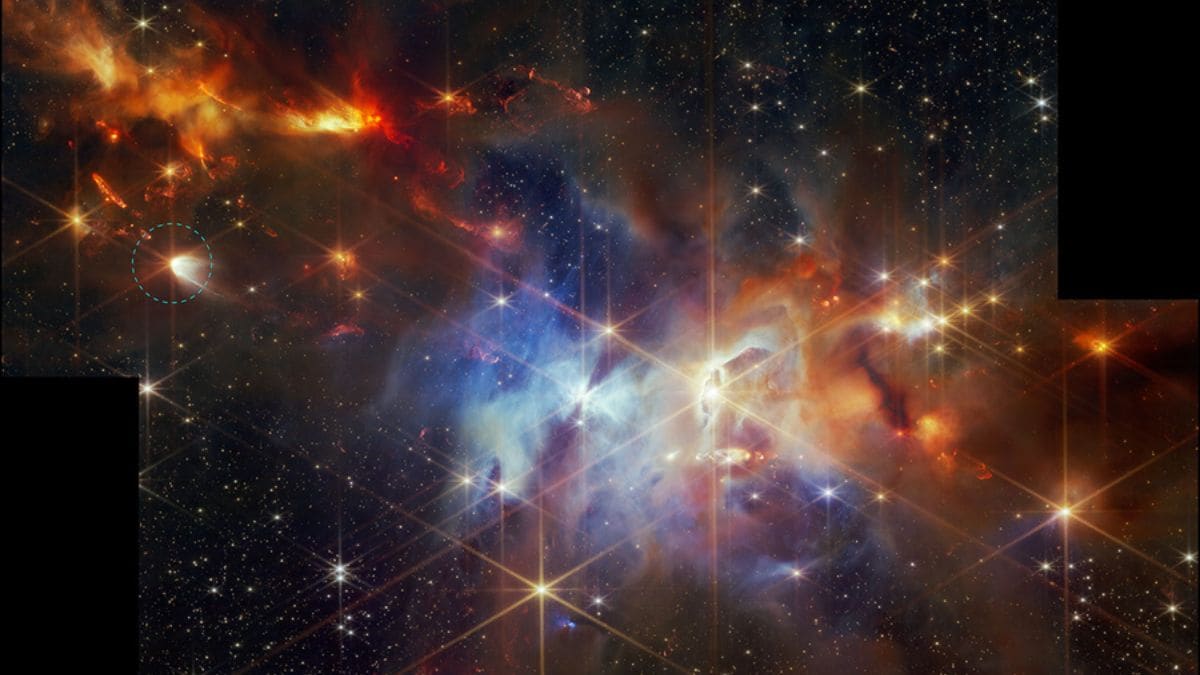
Using NASA’s James Webb Telescope, astronomers have witnessed a young, Sun-like protostar within the Serpens Nebula named EC 53 actively forging crystalline silicate minerals within its surrounding disk. There has been much speculation regarding how comets, literally frozen in space, could compose a crystal that requires intense heat to form. Now, thanks to data from Webb, scientists have evidence that periodic outbursts from EC 53 heat its inner disk enough to form the silicate crystals, then fling them outward with its stellar winds.
Young Star Forges Crystals
According to the new paper, the team of researchers focused on the EC 53 during the quiet state as well as during the eruptive state. The infrared spectra observed by Webb showed crystalline silicate features during star eruptions, confirming that the silicate crystals are formed in the hot inner disk region of the star, because it is the only time when the spectra appear. The results verified that forsterite and enstatite, the two major silicate compounds on Earth’s crust, are present in the silicate crystals. Every outburst helps ‘bake’ the dust into crystals, which are subsequently transported by the star’s jets of gas and winds toward the outer edge of the disk, which is cold.
Building Planets from Stardust
These silicate crystals are nothing but the same kinds of minerals that comprise 90 percent of Earth’s crust. The formation of these crystals in situ, as well as their migration outwards, have been cited as reasons for icy comets and planet-forming disks containing similar crystals. By revealing this process, Webb provides insight into a key stage of planet formation: over millions of years, the tiny crystalline grains can stick and grow into larger bodies, ultimately building rocky planets and icy worlds.