


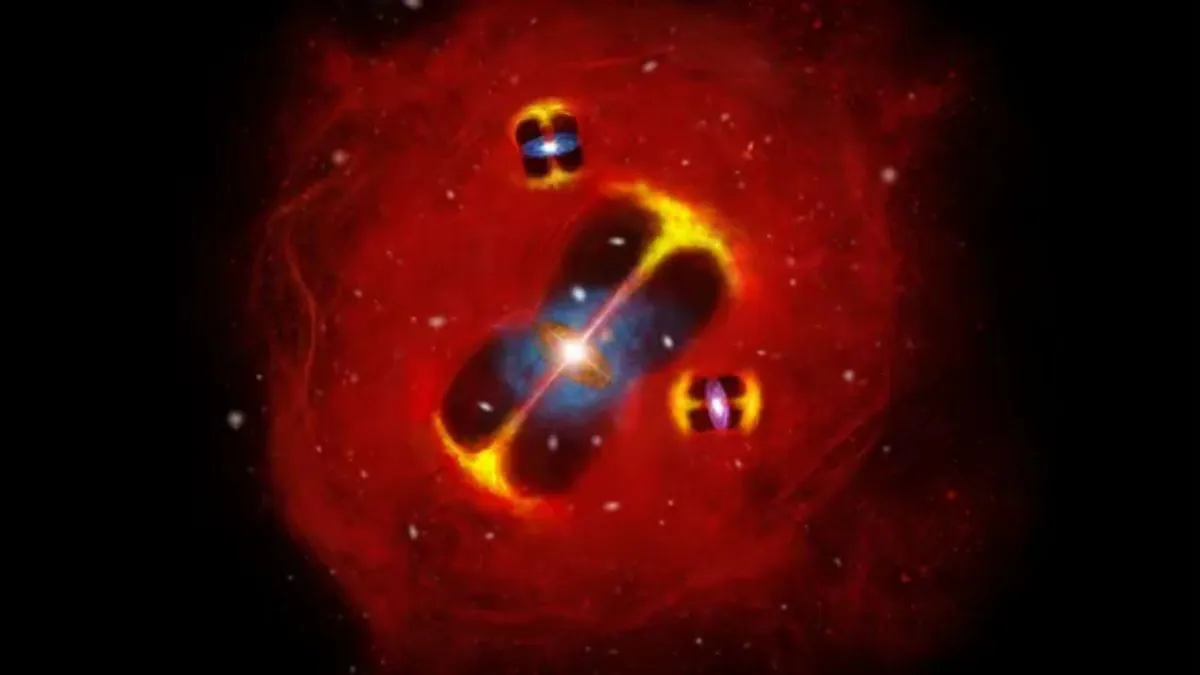
Astronomers at the University of British Columbia (UBC) and Dalhousie University have discovered a galaxy cluster blazing with hot gas just 1.4 billion years after the Big Bang — far earlier and hotter than theory predicts. Observations with ALMA show its gas is at least five times hotter than models allow. Lead author Dazhi Zhou (UBC) says the result, published in Nature, could upend current theories of cluster formation.
A blazing young cluster
According to the study, astronomers focused on a “baby” cluster nicknamed SPT2349-56, seen when the universe was just 1.4 billion years old. Observations with the ALMA radio array reveal this infant cluster is unusually massive: its core spans about 500,000 light-years and contains over 30 active galaxies forming stars at thousands of times the Milky Way’s rate. SPT2349-56 is known to host dozens of starburst galaxies and several supermassive black holes in its compact core. The team notes that powerful outflows from these black holes could be injecting enormous energy into the gas, explaining its extreme heat.
Rethinking galaxy cluster formation
The standard models envisaged that the cluster gas heats up slowly as galaxies form. However, the identification of superheated gas in this 1.4 billion-year-old cluster indicates that the formation was much more violent and efficient than what was assumed. Interestingly, this is the furthest back direct detection of hot cluster gas that has ever been made. Hence, scientists are compelled to change the theories of galaxy and cluster evolution. The researchers comment that this initial overheating stage might have been the key in turning the young groups into the hot systems we see today.
Get your daily dose of tech news, reviews, and insights, in under 80 characters on Gadgets 360 Turbo. Connect with fellow tech lovers on our Forum. Follow us on X, Facebook, WhatsApp, Threads and Google News for instant updates. Catch all the action on our YouTube channel.