


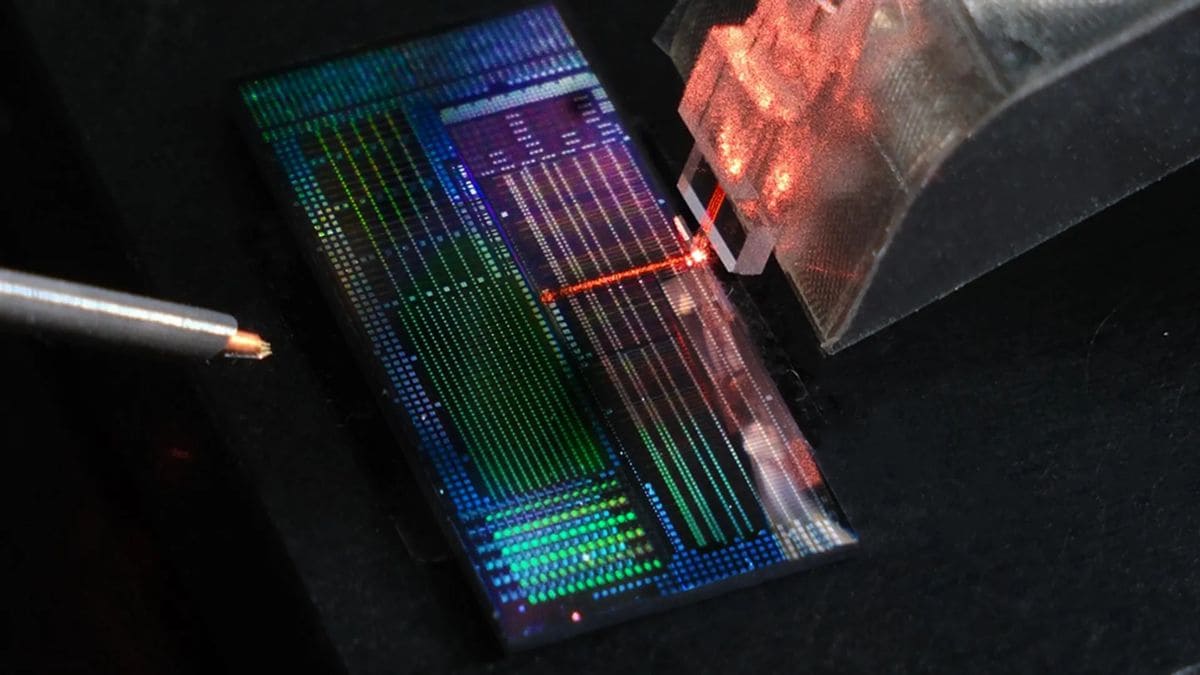
A new microchip that enables photon-photon interaction in a compact integrated device could be used to make quantum computing possible, where a huge number of superpositions can be maintained at the same time. And being 100 times thinner than human hair, the device is produced using standard chip manufacturing techniques for scalability toward mass production. The advance lets quantum machines address thousands or even millions of qubits, the fundamental units of quantum information, potentially transforming the future of computation, quantum sensing, and quantum networking.
Stable Laser Frequencies Pave the Way for Precision in Quantum Computing
According to a Nature Communications report, the research was led by Jake Freedman and Matt Eichenfield, in collaboration with Sandia National Laboratories. To do so, the researchers made a new optical phase modulator in which microwave vibrations oscillate trillions of times per second to coax superstable laser frequencies.
This level of control is essential for trapped-ion or neutral-atom quantum computers, for which each atom functions as a qubit and needs to be manipulated by accurately tuned laser beams.
Power-Efficient Photonic Chip Promises Scalable Quantum Computing Integration
Currently, similar frequency shifts have been demonstrated by bulky table-top devices, which consume high power, making them inconvenient to scale up The new chip reduces power usage by up to 80 times, producing far less heat and allowing many channels to be integrated closely on a single chip.
Made entirely in a CMOS fabrication facility, the device uses mass-manufacturing methods already common in modern electronics, promising thousands of identical photonic devices suitable for quantum systems. Researchers are now working on fully integrated photonic circuits to combine laser control, filtering, and pulse shaping, moving closer to operational large-scale quantum computers.