

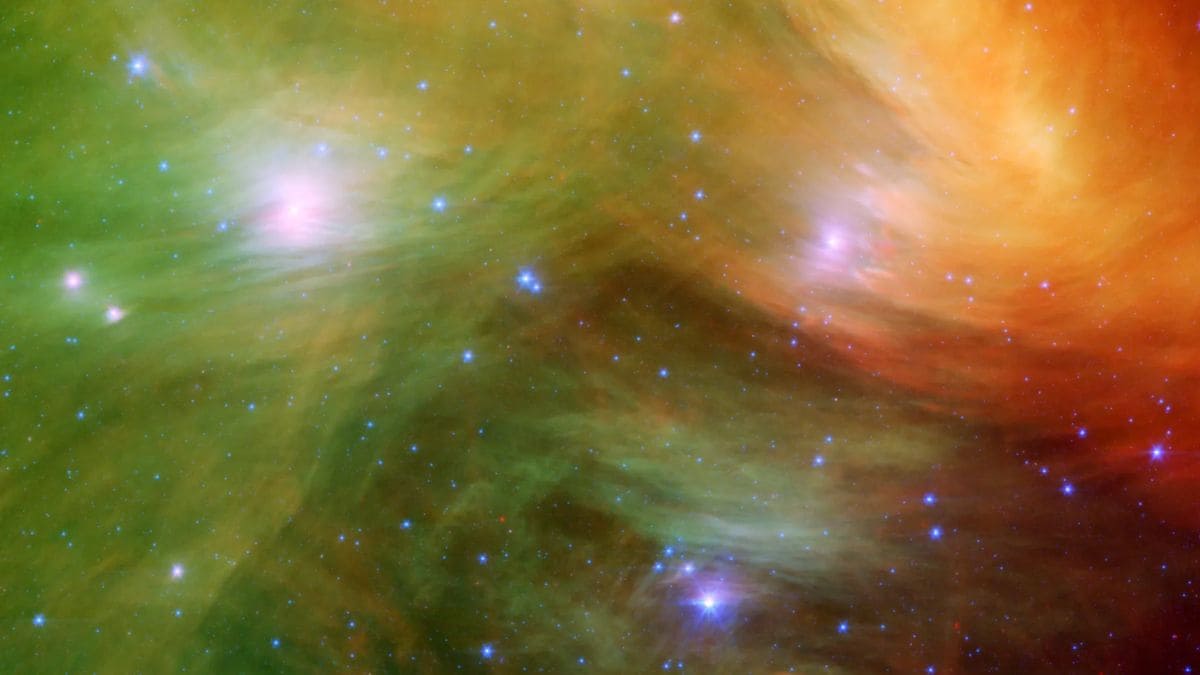
Astronomers have found that the Pleiades star cluster, also referred to as the “Seven Sisters”, is just the bright center of a larger stellar family of young stars. And, using the data generated from the ESA’s Gaia satellite and from NASA’s TESS mission, researchers identified thousands of other “sibling” stars scattered in the sky. The “Greater Pleiades Complex” is roughly 2,000 light-years long, and the cluster represents over 3,000 members, roughly 20 times larger than previously thought.
Hidden Depths of the Pleiades
According to the study, at first, astronomers used stellar rotation as a cosmic clock to pick out stars of the same age: young stars spin rapidly, while older stars slow down. By matching TESS rotation periods with Gaia’s precise positions and motions, the team identified about 3,100 stars roughly 100 million years old moving in lockstep across nearly 600 parsecs. Tracing their orbits backwards reveals these stars occupied a compact region 100 million years ago and so must have had a common origin in a single giant molecular cloud.
Origins and Significance of the Cluster
The Pleiades, which contain open clusters, come together in large molecular clouds and slowly disperse over tens of millions of years. The Pleiades is among the closest young clusters; 127 million years old and 440 light-years away, it is a key research facility for stellar evolution.
It also has important cultural significance across cultures, in mythologies, and even in the Subaru logo. Finding out that the star family is already hidden and that this is how, as the Sun might be missing, its members may help reveal how the stars move forward and break apart, and this could help explain what the Sun is.
Get your daily dose of tech news, reviews, and insights, in under 80 characters on Gadgets 360 Turbo. Connect with fellow tech lovers on our Forum. Follow us on X, Facebook, WhatsApp, Threads and Google News for instant updates. Catch all the action on our YouTube channel.