


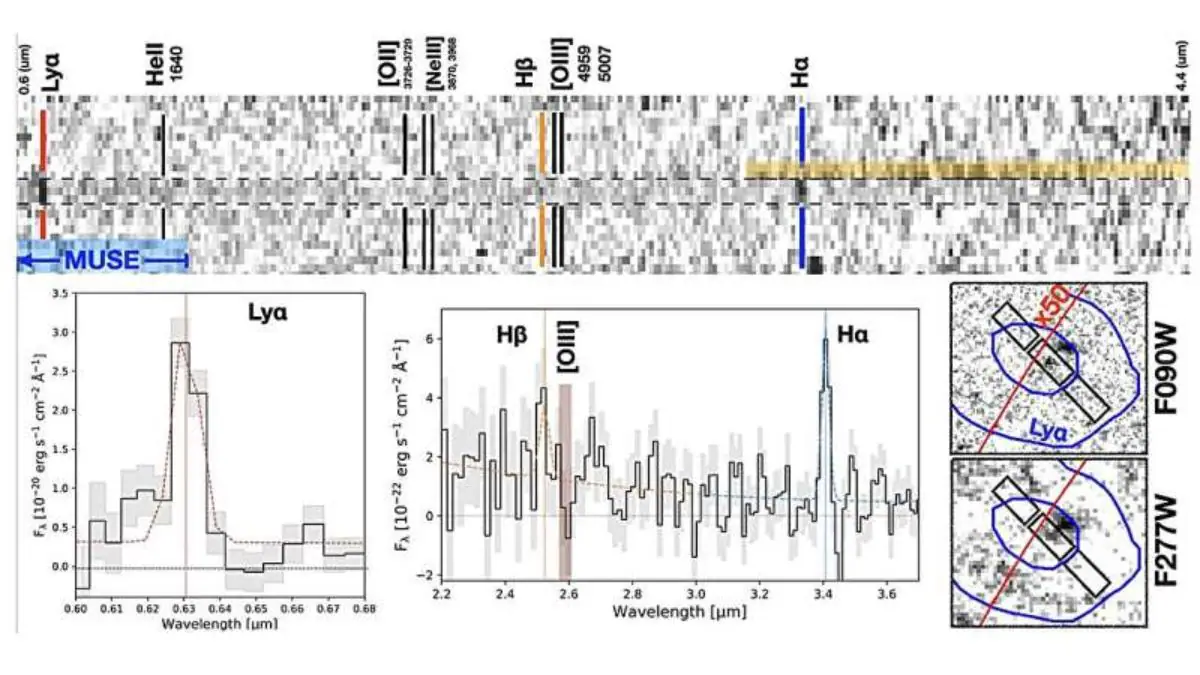
A group of astronomers from the James Webb Space Telescope (JWST) have found a faint star-forming section that offer clues regarding conditions similar to what we’ve seen in the early universe. The discovery, called LAP2, was reported in a paper posted on the arXiv preprint server Tuesday. The find represents an amazing chance to probe a system with an extraordinarily low abundance of metals and watch how the first stars influenced later parts of the universe. The system probably looked like a stellar nursery shortly after the Big Bang, researchers mentioned.
JWST Reveals LAP2, a Tiny Metal-Poor Star-Forming Complex Behind Abell 2744
As per the study led by Eros Vanzella of the Astrophysics and Space Science Observatory in Bologna, Italy, LAP2 was detected behind the massive galaxy cluster Abell 2744, which acted as a natural gravitational lens. Resolved spectroscopy reveals a 100 km/s RV velocity, and UV (luminosity) estimates can provide metal abundance measures (< ∼0.6%) which are five times more metal poor than any other known galaxy.
Astronomers have also discovered that LAP2 is extremely young, less than ten million years old, and with a mass between 10 and 100 thousand times the one of our sun: it’s just entered the main sequence phase in its very long life cycle, preserving almost all its pristine nature.LAP2 is a rare low-mass, most importantly very low-metallicity target that JWST will be required to measure metallicities and star-formation histories in order to understand the progenitor systems of gravitational wave sources.
Next step would be to apply the method to real data, but that’s easier said than done as oxygen and metallicity abundances are two sides of coin – not independent. This degeneracy complicates attempting to test or calibrate the Stellar Population Models which are used to drive Galactic Chemical Evolution (GCE).
For details of the latest launches and news from Samsung, Xiaomi, Realme, OnePlus, Oppo and other companies at the Mobile World Congress in Barcelona, visit our MWC 2026 hub.