


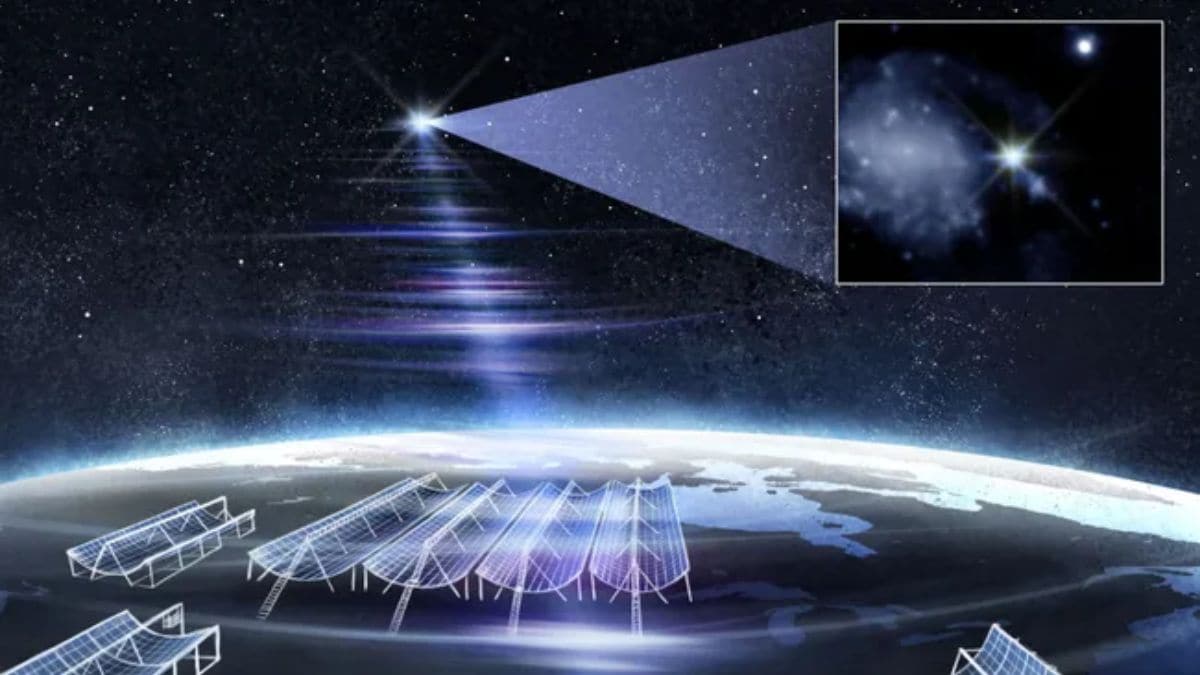
An international team of scientists including physicists at MIT have detected and a near and ultrabright fast radio burst some 130 million light-years from Earth in the constellation Ursa Major using the Canadian Hydrogen Intensity Mapping Experiment (CHIME) in March 2025. It is also the brightest — so bright that the signal has garnered the informal moniker, RBFLOAT, for “radio brightest flash of all time.” Fast radio bursts (FRBs) are millisecond-long flashes of cosmic radio waves that emit more energy in a moment than the Sun does in an entire day. RBFLOAT’s relative closeness and intensity gave scientists an opportunity to study it in detail.
Discovery of RBFLOAT
According to a study, by combining CHIME with three outriggers across North America and creating a continent-sized interferometer, astronomers localized the burst to a tiny region in the galaxy NGC-4141, about 130 million light-years away.
JWST then imaged RBFLOAT’s host galaxy, capturing its stellar neighbourhood with unprecedented clarity. Webb’s infrared camera pinpointed a faint source (NIR-1) close to the burst site, which may orbit an unseen neutron star or magnetar whose sudden flare caused the burst.
New Clues and Future Research
Fast radio bursts (FRBs) are brief flashes of radio waves that first appeared in data in 2007. They last only a few milliseconds and rarely repeat, which makes them very hard to study. By pinpointing RBFLOAT’s home galaxy, astronomers have opened a new window on FRBs. Imaging with the James Webb Space Telescope revealed a faint infrared glow near the burst site. This source (NIR-1) appears to be a red giant or massive star, possibly in a binary with a neutron star or magnetar pulling material from it.
Such a system could explain the burst’s immense power. With the source known, scientists can begin testing whether FRBs come from dying stars, magnetars or something else. Because RBFLOAT was unusually bright and relatively close, researchers studied it in great detail. Scientists plan to use JWST and other telescopes to follow up future bursts quickly.